Features of Ukraine
Ukrainians have a rich folk culture.
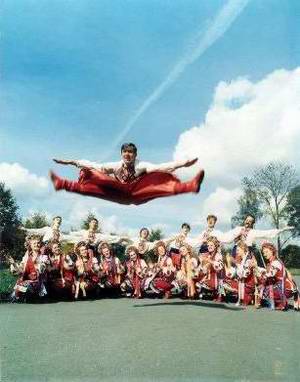
Hopak is a popular and energetic folk dance involving a competition among dancers. The name is coming from the Ukrainian “hop” - exclamation uttered during the dance. People usually dance hopak in Ukrainian folk costumes. Basic movements include running, wide and high jumps with flapping feet.
Ukrainian culture - hopak dance
Bandum, a lutelike instrument with 50 or more strings, is Ukraine’s national musical instrument.
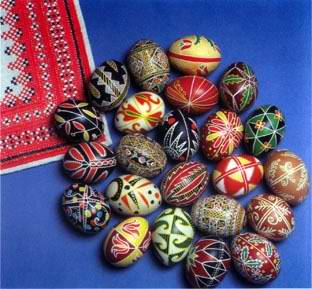
Pysanky are intricately designed ornamental Easter eggs, bearing Christian or pre-Christian symbols. Colorful wood-carvings are produced by artisans of the Carpathian Mountains area.
Ukrainian culture - Pysanky
Among the main national dishes of Ukrainian cuisine are borscht (other spelling borsch) - a soup made of beets, cabbage, and meat; rarcnyhy - boiled dumplings tilled with potatoes, cheese, sauerkraut, or berries and served with cream; holubtsi - stuffed cabbage rolls; and various sweet breads such as pasha, served at Easter time.
Other foods typical for Ukraine are pork, chicken, fish, potatoes, buckwheat, sour rye bread, and drinks such as tea, coffee, and honey liqueur.
Ukrainian literature
The earliest writings of Ukrainians, works produced in Kievan Rus from the 11th to the 13th century, were composed in Church Slavonic and are thus the common literary heritage of Russians and Belorussians as well.
After the Mongols invasion (the 13th century), Ukrainian literature was in decline until its revival in the 16th century. By the early 19th century, Ukrainian vernacular became the primary vehicle of literary expression, and an era of prolific writing began.
In the 19th century, Ukrainian literature reflected the rapid development of Ukrainian national consciousness under Russian rule.
Ivan Kotlyarevsky, classicist poet and playwright, inaugurated modern Ukrainian literature with his Eneida (1798), a burlesque travesty of Virgil’s Aeneid that transformed its heroes into Ukrainian Cossacks.
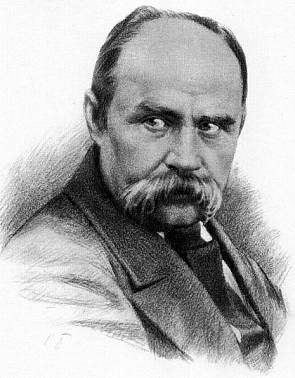
Taras Shevchenko
Taras Shevchenko (1814 - 1861) is Ukraine’s most prominent literary figure and national patriot. The early poetry of Shevchenko expressed the interests of the Romantics.
But soon his poetry moved to a more sombre portrayal of Ukrainian history, especially in the long poem Haidamaky (1841; “The Haidamaks”), and the works satirizing Russia’s oppression of Ukraine - e.g. Son (“The Dream”), Kavkaz (“The Caucasus”), and Poslaniie (“The Epistle”). His later poetry, written after his release (1857) from exile, treats broader themes.
Taras Shevchenko
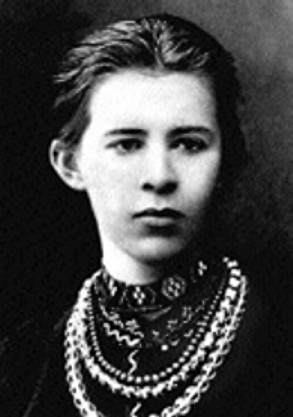
Lesya Ukrainka
Lesya Ukrainka is the pseudonym of Larisa Petrovna Kosach-Kvitka (1871-1913). Lesya Ukrainka was a poet, dramatist, short-story writer, essayist, and critic who was the foremost woman writer in Ukrainian literature and a leading figure in its modernist movement.
Her early lyrical verse, influenced by Taras Shevchenko, dealt with the poet’s loneliness and social alienation and was informed by a love of freedom, especially national freedom. She was active in Ukrainian struggle against tsarism and joined Ukrainian Marxist organizations, translating the Communist Manifesto into Ukrainian in 1902.
In 1907 she was arrested and, following her release, was kept under observation by police. She married the court official Klyment Kvitka in 1907.
Her plays were inspired by various historical milieus - e.g., the Old Testament in Oderzhyma (1901; “A Woman Possessed”) and Vavylonsky polon (1908; The Babylonian Captivity), the world of ancient Greece and Rome. Her historical drama “Boyarynya” (1914; The Noblewoman) is a psychological tragedy centering on Ukrainian family in the 17th century.
Lesya Ukrainka also wrote short stories and critical essays and did masterful translations of works by Homer, William Shakespeare and Lord Byron.
Lesya Ukrainka